Where music and dances come from
Instruments, styles of music and dances crossed oceans with sailors, migrants and records. Each story shows where one was born and how the rest of the world picked it up.
24 stories from 6 continents
- Africa · 3
- Asia · 5
- Europe · 5
- North America · 5
- South America · 4
- Oceania · 2
Africa

Congolese rumba (music)
📍 Kinshasa & Brazzaville (the two Congos)
Congolese rumba took shape in the 1940s and '50s in Kinshasa and Brazzaville, twin capitals facing each other across the Congo River, as local bands mixed their maringa dance music with Cuban son records wrongly labelled 'rumba'. UNESCO listed it in 2021.

Pipe organ
📍 Alexandria, Egypt
The pipe organ began in Alexandria in the 3rd century BC, when the Greek engineer Ctesibius built the hydraulis, a 'water organ' that used water pressure to push air through its pipes. It was the world's first keyboard instrument.
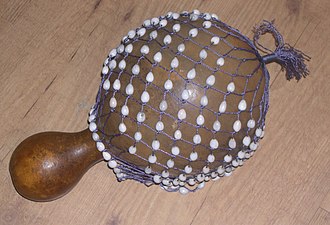
Shekere (beaded gourd rattle)
📍 Yorubaland (SW Nigeria & Benin)
The shekere, a dried gourd wrapped in a net of beads or cowrie shells, comes from the Yoruba of West Africa; an 1852 Yoruba dictionary already lists it. It later became a staple of Cuban and Brazilian music too.
Asia

Angklung (bamboo shaken instrument)
📍 West Java (Sundanese lands), Indonesia
Each bamboo angklung plays just one note when shaken, so a tune needs a whole team of players. The Sundanese have played it for centuries; in 1938 Daeng Soetigna of Bandung made one tuned to Western scales.

Dragon dance
📍 China
The dragon dance has roots more than 2,000 years old in Han-dynasty China, when dances with dragon figures were part of rituals to ask for rain. Today a team lifts the long dragon on poles, and big parade dragons often stretch 50 to 70 metres.

K-pop (music)
📍 Seoul, South Korea
Modern K-pop is usually dated to 11 April 1992, when Seo Taiji and Boys performed 'I Know', a mix of rap and dance pop, on a Korean TV talent show. The judges gave them the lowest score of the night; the song then topped the charts for 17 weeks.

Tabla (pair of hand drums)
📍 Northern India (around Delhi)
The tabla, a pair of hand drums, took shape in northern India in the 1700s; its first known master, Sidhar Khan, played in Delhi. The black circle on each drumhead, the syahi ('ink'), is layers of rice paste and black powder that make the drums sing.

Taiko ensemble drumming (kumi-daiko)
📍 Suwa, Nagano, Japan
Taiko drums are centuries old, but the thundering taiko ensemble was born in 1951 in Nagano, Japan, when former jazz drummer Daihachi Oguchi rearranged an old drum score for a team playing drums of different sizes. He then led its spread across Japan and the US.
Europe

Ballet
📍 Renaissance courts of northern Italy
Ballet was born in the courts of Renaissance Italy in the 1400s; the word comes from Italian 'balletto'. Catherine de' Medici took it to France, and Louis XIV founded a royal dance academy in 1661, which is why its steps have French names.

Bandoneon
📍 Germany (Krefeld & Chemnitz)
Tango's signature instrument is German. Krefeld music dealer Heinrich Band developed the bandoneon from the concertina in the mid-1800s, and emigrants and sailors later carried it to Buenos Aires and Montevideo.

Piano
📍 Florence, Italy
Bartolomeo Cristofori, instrument maker at the Medici court in Florence, had built the first piano by 1700. A court inventory praised his new keyboard as one 'che fa il piano, e il forte' (that plays soft and loud), hence its name.

Saxophone
📍 Brussels, Belgium
Jazz made it famous in America, but the saxophone was built around 1840 by Belgian instrument maker Adolphe Sax in Brussels. He then moved to Paris and patented the whole sax family in 1846.

Waltz (the dance)
📍 Alpine Bavaria & Austria
The waltz began in the 1700s as a country dance of the Alps, whirled by peasants in Bavaria, Tyrol and Styria; its name comes from German 'walzen', to turn. Vienna's ballrooms made it famous, though critics long called its close embrace indecent.
North America

Blues (music)
📍 Deep South, USA (Mississippi Delta)
The blues grew out of African-American songs in the Deep South around the 1860s. In about 1903 bandleader W.C. Handy heard it at a Mississippi railway station, from a man sliding a knife along his guitar strings: 'the weirdest music I ever heard'.

Cha-cha-chá (music and dance)
📍 Havana, Cuba
Cha-cha-chá was born in Havana in the early 1950s: violinist Enrique Jorrín of the Orquesta América wrote 'La engañadora' there in 1951. Its name is said to copy the sound dancers' shoes made as they grazed the floor on three quick steps.

Hip hop (music)
📍 The Bronx, New York City, USA
Hip hop grew up in the 1970s, and its best-known birthday is 11 August 1973: a back-to-school party in a Bronx apartment block, where Jamaican-born DJ Kool Herc played two copies of the same record on two turntables to stretch out the drum break the dancers loved.

Reggae (music)
📍 Kingston, Jamaica
Reggae grew out of ska and rocksteady in the late 1960s, mainly in the poor neighbourhoods of West Kingston, Jamaica. Toots and the Maytals' 1968 'Do the Reggay' was the first popular song to use the name, and UNESCO listed reggae in 2018.

Tap dance
📍 Eastern United States (New York to the South)
Tap dance grew up in the United States, where African American dance met Irish jigs and English clogs. A pioneer was William Henry Lane, "Master Juba", who danced in New York's Five Points as a teenager in the early 1840s, likely blending African American steps with jigs.
South America

Choro (music)
📍 Rio de Janeiro, Brazil
Choro, often called the first typically Brazilian urban popular music, was born in 19th-century Rio de Janeiro. In the 1870s the flautist Joaquim Callado led a group called 'Choro Carioca' with guitar and the small four-string cavaquinho.

Marinera (the handkerchief dance)
📍 Coast of Peru (Lima to Trujillo)
Marinera is a courtship dance where partners flirt with waving handkerchiefs; in the northern style women dance barefoot. It took its name in 1879 in honour of Peru's navy, and the national contest began in Trujillo in 1960.

Siku (panpipes played in pairs)
📍 Lake Titicaca (Peru & Bolivia)
The siku is the panpipe of the Andes, most at home among the Aymara around Lake Titicaca. Its pipes come in two halves, ira and arka, traditionally played by two musicians who alternate notes to build a single melody.

Tango
📍 Río de la Plata (Buenos Aires & Montevideo)
Tango was born in the 1880s in the port cities of Buenos Aires and Montevideo on the Río de la Plata. In the early 1900s it was often danced by two men, because there were more men than women on the dance floor.
Oceania

Didgeridoo
📍 Arnhem Land, Australia
Aboriginal peoples of northern Australia, probably in Arnhem Land, developed it centuries before Europeans arrived. The name 'didgeridoo' isn't Aboriginal; it's an imitative English word first printed in 1908.

Ukulele
📍 Honolulu, Hawaii
Madeiran craftsmen who sailed to Hawaii in 1879 turned their little machete guitar into the ukulele in the 1880s, and King Kalākaua made it a royal favourite. The Hawaiian name roughly means 'jumping flea'.